
Published by Upcyclea | UK Resources | Built Environment Decarbonisation
A Green Building is Not the same as a Documented Building
London has pursued built environment sustainability with a rigour that few comparable cities can match. Through successive iterations of BREEAM certification, the progressive tightening of the London Plan’s energy and sustainability policies, and the landmark introduction of mandatory Whole Life-Cycle Carbon (WLC) Assessments and Circular Economy Statements under the 2021 London Plan, the Greater London Authority has embedded carbon transparency into the planning system in ways that are now being emulated across the UK. The ambition is clear: the UK built environment is directly responsible for 25% of national carbon emissions and carries a moral and legal responsibility to rapidly decarbonise UKGBC.
Yet even a building that achieves BREEAM Outstanding today carries a critical blind spot: its material composition is almost entirely undocumented in a structured, machine-readable, lifecycle-persistent format. The architects who designed it hold drawings and specifications. The contractors who built it hold procurement records. The facilities manager who operates it holds maintenance logs and asset registers. None of these documents is designed to survive the building, to be queried by the next owner, or to enable the systematic recovery of the building’s material value when the time comes for retrofit or redevelopment.
This is the gap that the building passport fills — and it is a gap that London’s decarbonisation trajectory can no longer afford to leave open.
What a Building Passport is
A building passport is a dynamic, structured, digital record that documents the material composition, component specifications, environmental characteristics, and maintenance history of a building throughout its entire lifecycle. It is not a PDF of the specifications. It is not a static BIM file. It is a living data layer that accompanies the building from design through construction, operation, renovation, and eventual deconstruction — and that connects to the broader information ecosystem of the built environment.
The core information layers of a building passport include:
Material inventory: What materials are present in the building, in what quantities, in what locations, and in what condition. This includes structural materials (concrete, steel, timber), envelope systems (curtain wall, cladding, roofing), MEP systems (HVAC, electrical, plumbing), and fit-out components (flooring, partitioning, furniture systems where relevant).
Environmental credentials: The embodied carbon content of each material layer, referenced to verified Environmental Product Declarations (EPDs) or the emission factors recognised under the RICS Whole Life Carbon Assessment Professional Statement and the LETI embodied carbon targets. This transforms the building from an opaque carbon liability into a transparent, auditable asset with a known environmental profile.
Component identity: Individual identification of significant components — structural elements, facade modules, MEP equipment — enabling tracking of warranties, maintenance cycles, and end-of-life eligibility for reuse. This is directly aligned with the golden thread of information requirements introduced under the Building Safety Act 2022.
Lifecycle events: A timestamped record of interventions — retrofits, component replacements, condition assessments — that updates the building’s material and carbon profile over time.
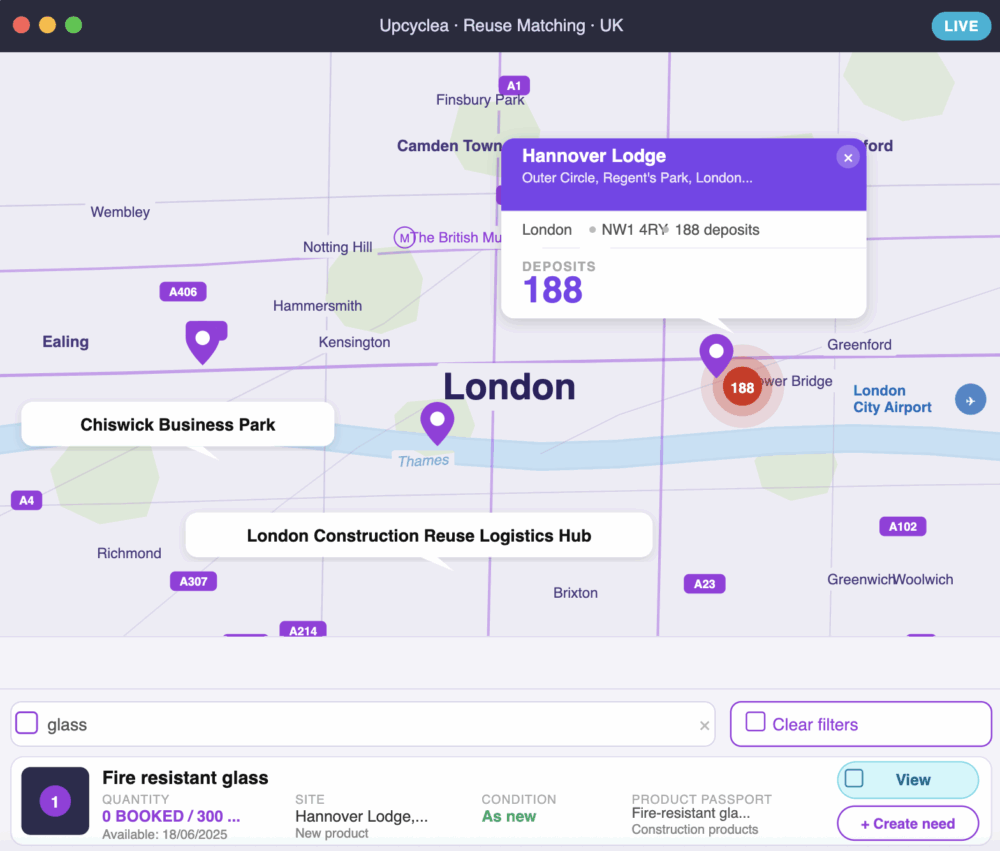
Reuse potential flags: Indicators that identify components suitable for secondary deployment at end of life, enabling pre-demolition planning and connection to urban mining platforms such as ROMULUS.
Why London Needs Building Passports Now
The UKGBC’s Net Zero Whole Life Carbon Roadmap — the built environment’s action plan to 2050 — is unambiguous about the scale of the challenge. Embodied carbon emissions have fallen by only 14 per cent since 2018, against the 24 per cent reduction the Roadmap requires — meaning the industry is cutting carbon at roughly half the speed needed, a gap of around 20 MtCO₂e per year. UKGBC Without knowing what materials are in buildings and what carbon those materials represent, credible reduction targets cannot be set, performance cannot be benchmarked, and progress cannot be verified. The building passport is the foundational data infrastructure that makes all of this possible.
Three specific policy developments make building passports urgent in London’s context:
The London Plan’s mandatory WLC and circularity requirements. Under the London Plan 2021, all residential developments of more than 150 units or over 30 metres in height, or commercial buildings covering more than 2,500 square metres, face mandatory Whole Life Carbon Assessment requirements. All referable planning applications must also submit a Circular Economy Statement demonstrating how secondary material use will be maximised and how the design enables disassembly and reuse of materials at end of life. Building passports are the natural vehicle for evidencing compliance with these requirements across a building’s full lifecycle — not just at the point of planning submission.
The GLA’s aspirational WLC benchmarks for 2030. All major applications submitted after 2030 are expected to achieve the GLA’s aspirational WLC benchmark as a minimum for all embodied carbon emissions, aligned with the World Green Building Council’s target of a 40% reduction in upfront embodied carbon. City of London Meeting these benchmarks requires primary data on material composition — data that currently exists for almost no building in London’s existing stock.
The Building Safety Act 2022 and the golden thread. The golden thread of information — the requirement to create, maintain, and hand over a structured digital record of a building’s design, construction, and modifications — establishes a regulatory precedent for lifecycle documentation that maps directly onto the building passport framework. For higher-risk buildings, this is already a legal obligation. For the wider commercial stock, it is the direction of travel.
The Passport as Financial Infrastructure
The environmental case for building passports is clear. The financial case is equally compelling, and in London’s sophisticated real estate investment environment, it may ultimately be more persuasive.
A building with a documented passport is a different financial asset from one without. The passport reduces due diligence costs for transactions and refinancings. It enables more accurate residual value assessments, including the value of recoverable materials at end of life. It provides the documentation required by green finance instruments — green bonds, sustainability-linked loans, transition finance facilities — whose terms are increasingly tied to verified environmental performance data rather than self-reported estimates.
For investors and asset managers operating under TCFD-aligned reporting frameworks, UK Sustainability Disclosure Requirements (SDR), or GRESB assessment criteria, a portfolio of documented buildings with known whole life carbon profiles represents a fundamentally lower-risk asset class than undocumented stock. The passport converts an opaque liability into a transparent, manageable, insurable asset.
The London market has also begun to price the cost of undocumented buildings directly: the GLA’s refusal of planning consent for Marks & Spencer’s proposed Oxford Street demolition and rebuild — on grounds that included insufficient consideration of whole-life embodied carbon — signals that material transparency is now a live planning risk, not merely a sustainability aspiration.
Upcyclea’s Building Passport Platform: Designed for London’s Regulatory Environment
Upcyclea’s building passport platform is calibrated to the specific regulatory, technical, and market context of the UK and London. It is built on emission factor data consistent with RICS Whole Life Carbon Assessment methodology and LETI benchmarks, integrated with GLA Circular Economy Statement requirements, and connected to the ROMULUS urban mining platform so that end-of-life material flows can be planned from the first day of a building’s operational life.
The platform enables building owners, developers, and asset managers to:
- Create structured digital material records at any stage of a building’s lifecycle, from new construction through major retrofit to pre-demolition audit, in full alignment with the London Plan’s WLC and CE requirements
- Calculate and track embodied carbon profiles referenced to RICS-compliant emission factors and LETI whole life carbon targets
- Generate documentation for BREEAM submissions, GLA planning applications, ESG reports, and green finance instruments
- Evidence compliance with the Building Safety Act’s golden thread requirements for higher-risk buildings
- Identify and flag components eligible for recovery and reuse, connecting directly to the ROMULUS secondary materials marketplace for London and the wider UK market
- Share verified data with tenants, investors, financiers, planning authorities, and regulators through controlled access protocols
The building passport is not an administrative burden. It is the data infrastructure that makes London’s built environment legible, tradeable, and progressively more circular. It is the answer to the question that every planning authority, every ESG investor, and every green finance provider is now asking: what is this building actually made of, and what will happen to those materials when it comes down?
Upcyclea’s Building Passport platform is operational in London. To learn more about implementation for your portfolio or project, contact our UK team or book a demonstration through our website.
References: UKGBC Net Zero Whole Life Carbon Roadmap (2021, Progress Report 2025); London Plan 2021, Policies SI 2 and SI 7; GLA Whole Life-Cycle Carbon Assessments and Circular Economy Statements London Planning Guidance (2022); RICS Whole Life Carbon Assessment for the Built Environment Professional Statement; LETI Embodied Carbon Primer; Building Safety Act 2022; WGBC Bringing Embodied Carbon Upfront (2019).