
Published by Upcyclea | Singapore Resources | Built Environment Decarbonisation
The City That Mines Itself
Singapore has always been a city of transformation. It turned swampland into a global financial hub, reclaimed land from the sea, and reinvented its economy multiple times in a single generation. Now, facing the pressures of the Singapore Green Plan 2030 and the Built Environment Decarbonisation Technology Roadmap published in 2025 by BCA and SGBC, the city-state is poised for its next reinvention: becoming a nation that mines its own buildings rather than demolishing them.
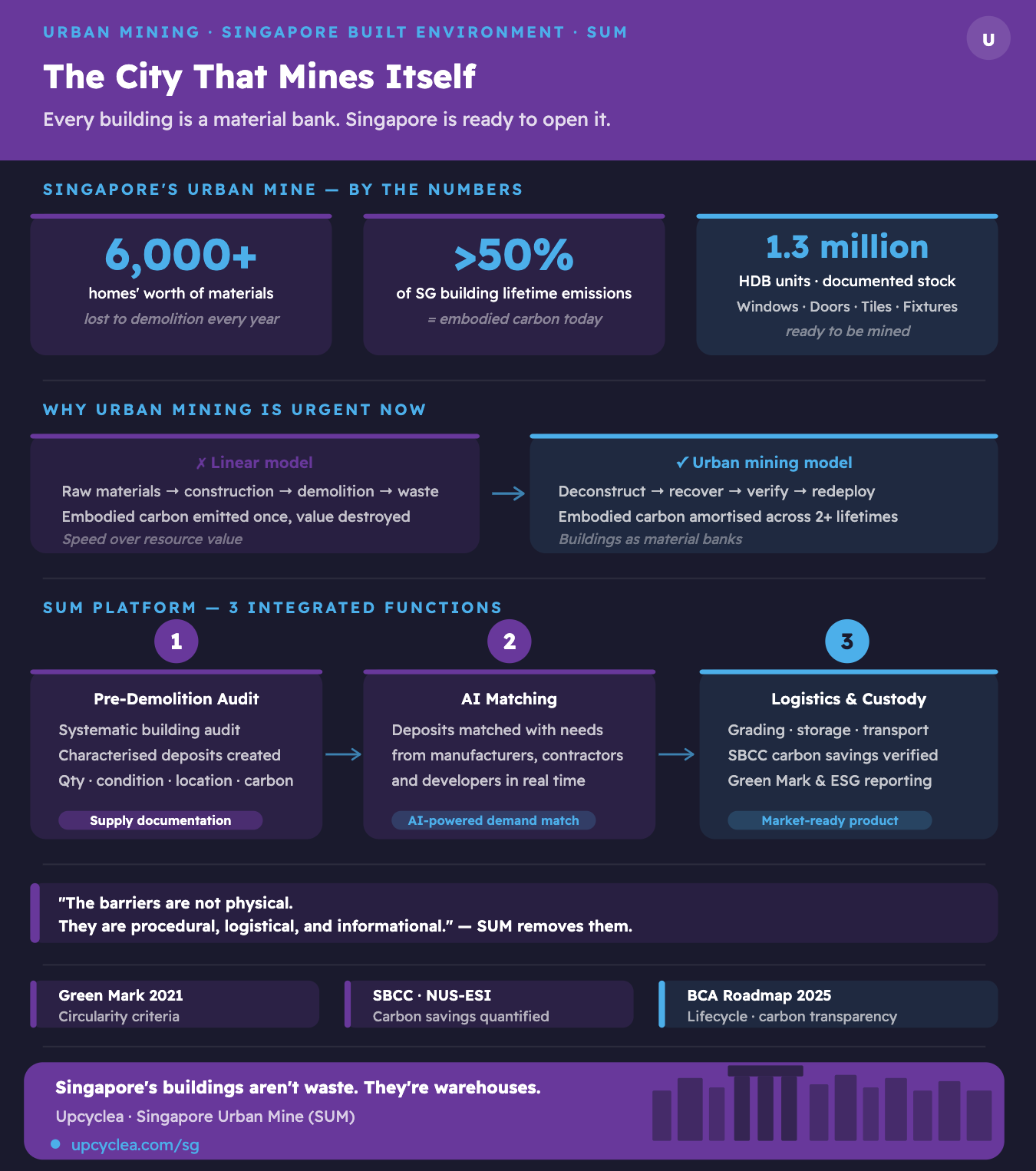
This is not a metaphor. Urban mining — the systematic recovery of building materials and components from end-of-life structures — represents one of the most powerful, and underutilised, levers available to Singapore’s built environment sector. Research conducted on Singapore’s public housing stock demonstrates that the city’s annual building outflows could support the construction of more than 6,000 low-cost houses in the region. Components including windows, doors, floor tiles, light fixtures, sanitary fittings and kitchen hardware represent a secondary resource stream of enormous economic and environmental value. That value is currently being destroyed in the name of speed.
Why Embodied Carbon Makes Urban Mining Urgent
The 2025 Built Environment Decarbonisation Technology Roadmap, co-developed by BCA, SGBC, and A*STAR, represents a watershed moment for Singapore’s construction sector. For the first time, embodied carbon — the carbon emitted during material production and construction, before a building is ever occupied — is placed at the centre of national climate strategy.
The reason is arithmetic. As Singapore’s buildings become more energy-efficient through the Green Mark scheme and the 80-80-80 targets of the Singapore Green Building Masterplan (SGBMP), the share of operational carbon in a building’s total lifetime footprint declines. The relative weight of embodied carbon therefore rises. The roadmap notes that upfront carbon — covering materials production and construction phases — has the potential to account for up to half of the entire carbon footprint of new construction between now and 2050. In Singapore, where building lifespans tend to be shorter than in European contexts due to urban renewal cycles, embodied carbon constitute today more than 50% of total lifetime emissions.
Material reuse addresses this challenge directly. When a structural steel beam is salvaged and reinstated, its embodied carbon — emitted during smelting and fabrication — is amortised across two or more building lifetimes rather than one. When a partition system, a curtain wall module, or a raised floor tile is recovered and redeployed, the embodied carbon of a replacement unit is simply not emitted. Urban mining is, at its core, a decarbonisation strategy for hard-to-abate upfront emissions.
The Supply Side: Singapore’s Building Stock as a Material Bank
Singapore’s public housing stock — comprising over 1.3 million residential units managed through the HDB programme — represents one of the most systematically documented built-environment inventories in Southeast Asia. This documentation is a foundation asset for urban mining. When building typologies are known, when construction periods are recorded, and when material compositions are catalogued, it becomes possible to predict the secondary resource flows that will emerge as buildings approach the end of their useful life.
Research into Singapore’s residential building stock has demonstrated feasibility across multiple dimensions. Component recovery times for standard building elements — doors, windows, tiles, fixtures — average between minutes and a few hours per item when workers are properly trained and equipped. Critically, Singapore’s regulatory demolition permit process already provides sufficient time windows for systematic pre-demolition salvage without disrupting project timelines. The barriers are not physical. They are procedural, logistical, and informational.
This is where digital platforms become decisive infrastructure.
Upcyclea’s SUM: Singapore’s Urban Mine, Operationalised
Upcyclea is launching the Singapore Urban Mine (SUM) platform precisely to bridge the gap between latent secondary resource potential and actionable market reality. SUM is not an inventory management tool. It is the operational backbone of a functioning secondary materials market — one that connects, thanks to AI, the supply of components recovered from end-of-life buildings with the demand for verified, qualified secondary materials in new construction and renovation projects.
The platform operates through three integrated functions. First, it enables the systematic audit of buildings before demolition (called Pre-Demolition Audit), creating characterized deposits that describe the quantity, condition, location, and environmental credentials of recoverable components. Second, its IA matches these deposits with needs declared by manufacturers, contractors, and developers. Third, it manages the logistical chain — condition verification, grading, storage, transportation, and chain-of-custody documentation — that transforms raw salvage into market-ready product.
SUM is aligned with Singapore’s regulatory environment. BCA’s Green Mark 2021 scheme explicitly incorporates circularity criteria. The Singapore Building Carbon Calculator (SBCC), developed by NUS Energy Studies Institute in collaboration with BCA and SGBC, provides emission factor data that quantifies the decarbonisation benefit of material reuse — enabling SUM users to demonstrate verifiable embodied carbon savings in project submissions and ESG reporting.
From Demolition to Deconstruction: The Policy Moment
The 2025 BE Decarbonisation Technology Roadmap calls explicitly for lifecycle thinking and material carbon transparency as foundational pillars of Singapore’s path to net zero in the built environment. These two pillars are exactly what urban mining, enabled by digital platforms, delivers.
Material carbon transparency requires knowing what a building contains, where those materials came from, and what emissions were incurred in producing them. A building that has been documented through a digital passport system provides this information at both the individual asset level and, aggregated, at the portfolio or national level. This is the data infrastructure that allows Singapore to set meaningful embodied carbon benchmarks, track progress over time, and align with international reporting frameworks including those emerging from the Global Alliance for Buildings and Construction.
Lifecycle thinking requires treating buildings not as linear consumption events — raw materials in, waste out — but as temporal storage systems for valuable resources. A concrete slab, a steel structure, a curtain wall system: these are not products. They are material banks. The question is not when they will be disposed of, but when they will be made available for their next deployment.
Singapore is the ideal environment for this transition. Its land constraints, its high construction intensity, its sophisticated regulatory apparatus, and its culture of systemic problem-solving create the conditions for urban mining to move from academic concept to mainstream practice. Upcyclea built SUM because the city was ready for it — and because the climate cannot wait for a slower transition.
Upcyclea operates the Singapore Urban Mine (SUM) platform, providing digital infrastructure for urban mining, building passports, and embodied carbon tracking across Singapore’s built environment. For more information or to register a demolition site or material requirement, contact our Singapore team.
References: BCA/SGBC Built Environment Decarbonisation Technology Roadmap (2025); Singapore Green Building Masterplan 4th Edition (2021); Arora et al., “Buildings and the circular economy: Estimating urban mining, recovery and reuse potential of building components” (2020); Arora et al., “Urban mining in buildings for a circular economy” (2021); Singapore Building Carbon Calculator, NUS-ESI/JTC/BCA/SGBC.