
Published by Upcyclea | Singapore Resources | Built Environment Decarbonisation
Beyond the Energy Bill: The Whole Life Carbon Imperative
Singapore’s built environment has spent nearly two decades engineering its way to lower operational energy. The results are real and significant: through the Green Mark scheme, minimum energy performance standards under the Building Control Act, the Super Low Energy Programme, and the Integrated and Aggregated Facilities Management grants, Singapore has demonstrably improved the energy performance of its building stock relative to 2005 baselines. The first two pillars of the 80-80-80 target — greening 80% of building GFA and moving 80% of new developments toward Super Low Energy standards — are structural achievements built on operational carbon reduction.
But a building’s carbon story does not begin when the first occupant walks through the door, and it does not end when the last one leaves. It begins in the quarry, the blast furnace, and the cement kiln. It runs through the fabrication plant, the logistics chain, and the construction site. It accumulates through decades of operation, maintenance, and periodic retrofit. And it concludes — or should conclude — with a deconstruction process that either recovers and redeploys the material value locked into the structure, or destroys it in a conventional demolition that generates construction and demolition waste while emitting additional carbon in transportation and processing.
This full accounting — from extraction through operation to end of life — is what the 2025 Built Environment Decarbonisation Technology Roadmap means by whole life carbon. And it is the framework within which Singapore’s most sophisticated developers, investors, and policymakers are now operating.
The Decarbonisation Roadmap’s Whole Life Architecture
The 2025 roadmap, developed by BCA and SGBC with support from A*STAR and informed by engagement with over 100 industry stakeholders, is structured around a whole life carbon approach that addresses both operational and embodied carbon across every phase of a building’s lifecycle. This represents a fundamental expansion of scope relative to Singapore’s previous sustainability frameworks.
The roadmap identifies close to 70 key technologies and strategies — across passive design, smart cooling, low-carbon construction materials, and circular economy practices — that can help building owners decarbonise their portfolios. It categorises these into market-ready solutions available for deployment today and emerging technology priorities that require further research, demonstration, and commercialisation support under Singapore’s Research, Innovation and Enterprise (RIE) 2030 plan.
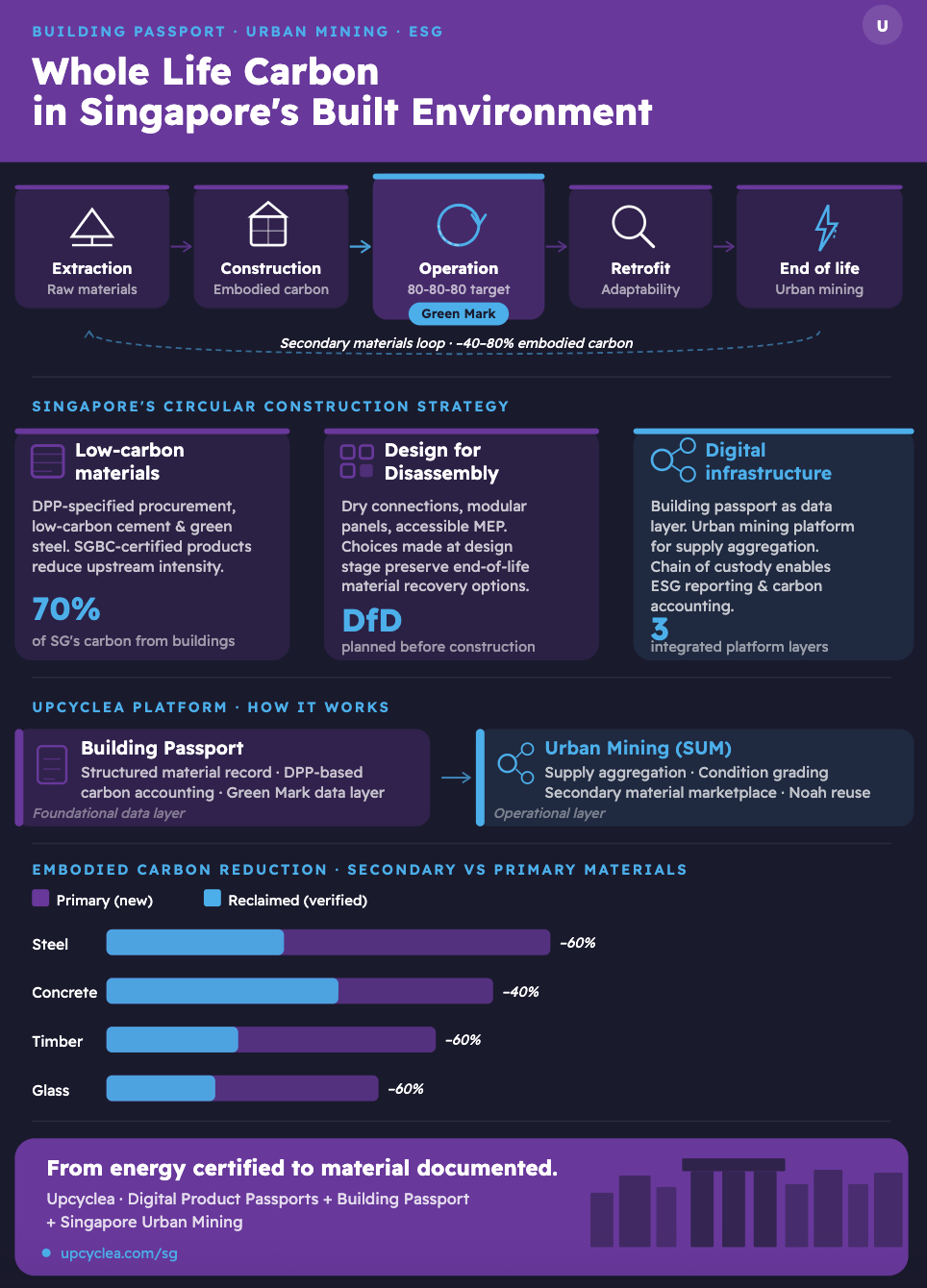
For embodied carbon specifically, the roadmap identifies three interconnected intervention areas: reducing the carbon intensity of new materials through low-carbon cement, green steel, and alternative structural systems; extending material lifespans through design for adaptability and deconstruction; and enabling material recovery and reuse through urban mining platforms and secondary material markets. These three areas are not alternatives. They are complementary strategies that must be pursued simultaneously to achieve meaningful whole life carbon reduction.
Circular construction is the integration of all three. It is the design philosophy, procurement practice, and operational model that treats materials as assets rather than inputs — assets that retain value across multiple building lifecycles rather than being consumed in a single use.
What Circular Construction Looks Like in Singapore’s Context
Circular construction in Singapore operates within specific constraints and opportunities that differ from European or North American contexts. Building heights are greater, structural demands are more intense, and the density of the urban fabric creates different material flow dynamics than in lower-density cities. Singapore’s land constraints mean that urban renewal is a permanent feature of the city’s development model — and urban renewal creates a continuous stream of building deconstruction that is either a waste problem or a resource opportunity, depending on how it is managed.
Several principles define circular construction practice in Singapore’s context:
Design for longevity and adaptability. The most circular building is one that does not need to be demolished. Buildings designed with flexible floor plates, generous structural grids, and accessible MEP distribution can accommodate successive waves of fit-out change without structural intervention. This extends the building’s useful life and defers the embodied carbon impact of replacement. Singapore’s high-rise residential typology — with its standardised structural systems and relatively simple envelope configurations — is particularly amenable to systematic adaptation strategies.
Specify for verified environmental performance. Circular construction requires supply chains that can demonstrate the environmental profile of their products. EPD-specified procurement, SGBC-certified materials under the Singapore Green Building Product scheme, and the use of the SBCC emission factor database for carbon accounting create the data foundation that makes circular design decisions meaningful rather than aspirational. A building specified and documented in this way can be understood as a carbon asset — with a known embodied carbon stock, a known operational carbon profile, and a projected end-of-life material recovery value.
Plan deconstruction before construction begins. Design for Deconstruction (DfD) is the practice of making deliberate structural and connection detail choices during design that facilitate component recovery at end of life. Dry connections rather than grouted fixings. Modular panel systems rather than site-cast cladding. Accessible floor tile installation rather than embedded adhesive bonding. These choices may add marginal cost at the point of construction — though in many cases they do not — but they preserve options that are otherwise foreclosed. The Singapore Urban Mine’s value depends critically on the recoverability of the components that enter its inventory. DfD creates the supply quality that makes the secondary materials market function.
Close the loop through documented material flows. The full circular logic requires that materials recovered from one building become verified, documented inputs to the next. This chain of custody — from deconstruction audit through condition grading, storage, and reinstallation — is what transforms urban mining from an informal salvage practice into a structured secondary materials market. It is also what enables the embodied carbon accounting that makes secondary materials attractive to specifiers: a verified reclaimed steel beam has a known embodied carbon, typically 40-80% lower than equivalent new production depending on origin, and that saving can be quantified, documented, and reported.
The Role of Digital Infrastructure
None of this is possible at scale without digital infrastructure. The material flows involved in Singapore’s built environment — across hundreds of construction projects, thousands of buildings, and millions of individual components — cannot be managed, verified, or optimised through manual processes or disconnected spreadsheets.
The building passport is the foundational data layer. It provides the structured, persistent material record that enables EPD-based carbon accounting, Green Mark documentation, ESG reporting, and end-of-life recovery planning. It is the digital equivalent of the geological survey that precedes a mining operation — the systematic documentation that allows the resource to be understood, valued, and extracted efficiently.
The urban mining platform is the operational layer. It aggregates supply across demolition sites, manages condition verification and grading, connects supply to qualified demand, and provides the chain of custody documentation that makes secondary materials bankable in a procurement and ESG reporting context.
BCA’s carbon calculation tools, SGBC’s certification frameworks, and Singapore’s emerging green finance ecosystem form the incentive and reporting layer — creating the market conditions that reward circular behaviour and penalise linear waste.
Upcyclea’s platform integrates these three layers in a single operational environment designed for Singapore’s built environment. The building passport and the urban mining marketplace are not separate products. They are connected functions of a single circular material intelligence system — one that allows Singapore’s buildings to know what they contain, to plan for what they will yield, and to demonstrate the environmental performance that a decarbonising capital market increasingly requires.
The Opportunity Window
Singapore is at a critical juncture. The 2025 roadmap has been developed; the targets have been set; the tools are being built. The national climate trajectory is clear. What remains is the translation of roadmap ambition into project-level practice — and the accumulation of the material documentation, market infrastructure, and professional competency that make whole life carbon management routine rather than exceptional.
The organisations that invest in circular construction capability now — in design for deconstruction, in EPD-specified procurement, in building passport documentation, in connection to urban mining platforms — will be the embodied carbon champions of the next decade. They will have the data, the verified performance history, and the market relationships that their competitors are still assembling.
Singapore has always competed on the quality of its infrastructure. Circular material infrastructure — the passports, the platforms, the markets, the metrics — is the infrastructure of the low-carbon built environment. It is being built now.
Upcyclea provides integrated building passport and urban mining platform services for Singapore’s built environment sector, supporting whole life carbon management from design through deconstruction. To learn more about circular construction implementation, contact our Singapore team or explore our resource library.
References: BCA/SGBC Built Environment Decarbonisation Technology Roadmap (2025); Singapore Green Building Masterplan 4th Edition (2021); BCA Green Mark 2021 Scheme; BCA Building Control Act minimum energy performance standards; SGBC Carbon Resources and Embodied Carbon Calculation Guide; Singapore Building Carbon Calculator, NUS-ESI/JTC/BCA/SGBC.