
Embodied Carbon Champions: How Singapore’s Built Environment Leaders Are Rewriting the Carbon Calculus
Published by Upcyclea | Singapore Resources | Built Environment Decarbonisation
The Metric That Changes Everything
For two decades, Singapore’s built environment sector measured its environmental progress in kilowatt-hours per square metre per year. Energy intensity was the denominator of sustainability — the quantity that Green Mark optimised, that tenants negotiated, that investors scrutinised. This was rational: operational carbon from building energy use dominated lifecycle emissions, and energy efficiency was a known, measurable, improvable quantity.
That logic is now being disrupted by the mathematics of decarbonisation itself.
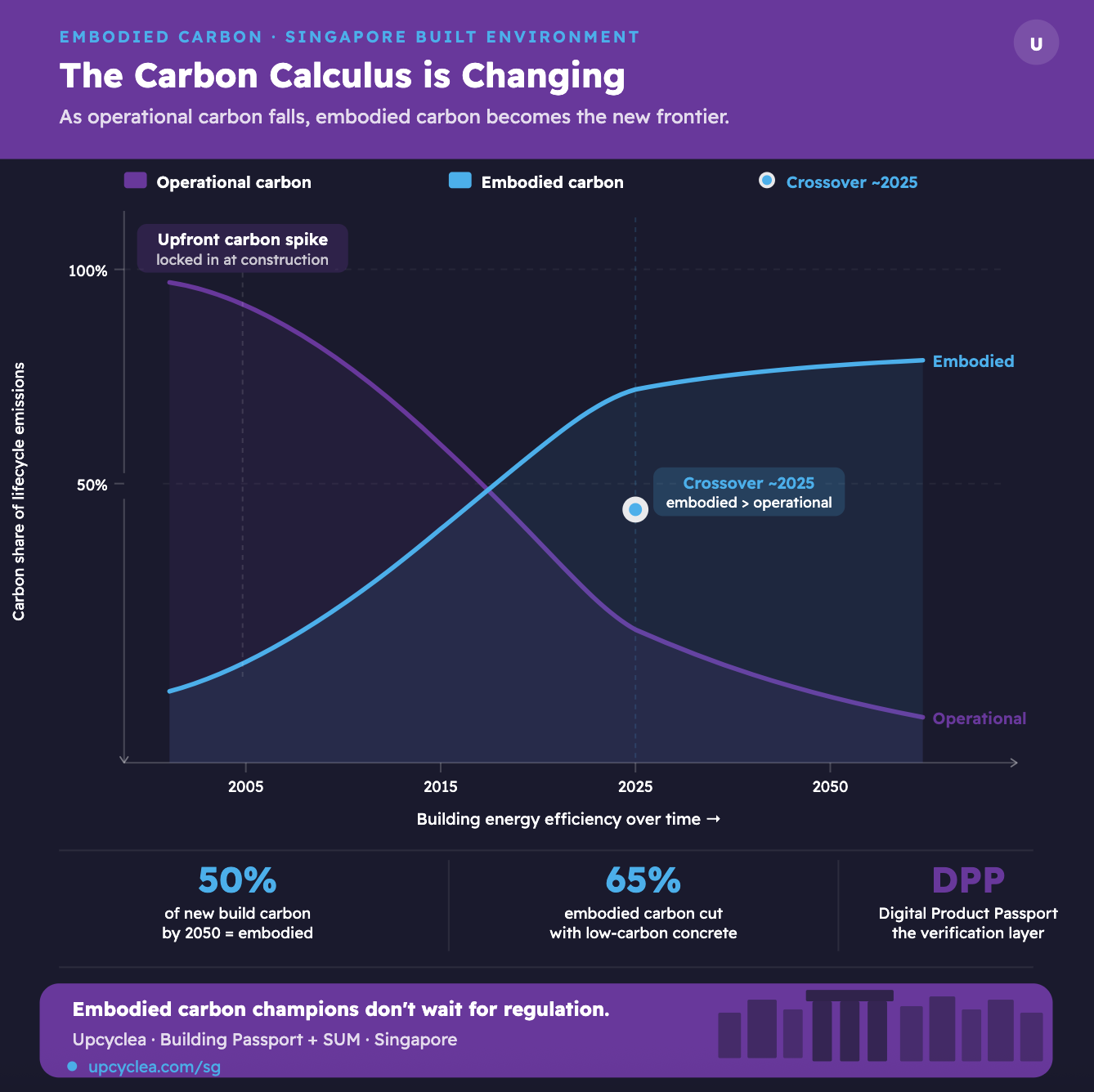
As Singapore’s buildings become more energy efficient — through better building envelopes, high-performance HVAC systems, smart energy management, and increasingly decarbonised grid electricity — the carbon emitted during a building’s operation declines. The carbon emitted during its construction does not. It was emitted when the cement was calcined, when the steel was smelted, when the aluminium was cast. It is already in the atmosphere before the building opens its doors. It cannot be offset by rooftop solar or improved chiller efficiency. It can only be avoided by choosing different materials, different structures, or different supply chains in the first place — or by recovering and reusing materials rather than producing new ones.
This is the reality that the 2025 Built Environment Decarbonisation Technology Roadmap confronts directly. BCA and SGBC state clearly that upfront carbon — the emissions resulting from materials production and construction before a building begins operating — has the potential to account for up to half of the entire carbon footprint of new construction between now and 2050. Singapore cannot reach its national climate targets without champions who are actively managing this number.
What Distinguishes an Embodied Carbon Champion
Embodied carbon leadership in Singapore’s built environment is not defined by ambition statements. It is defined by measurement, reduction, and verification — and by the willingness to make material choices that a purely cost-optimised procurement process would not make.
An embodied carbon champion operates across four dimensions:
Measure first. The Singapore Building Carbon Calculator (SBCC), developed by NUS-ESI in collaboration with JTC, BCA, and SGBC, provides Singapore’s built environment with a free, locally calibrated tool for calculating the embodied carbon of building and construction activities. It uses emission factors specific to Singapore’s material supply chains — not global averages that may misrepresent actual emissions from regionally sourced materials. Embodied carbon champions use this tool not as a compliance exercise but as a design instrument, running calculations at concept stage to compare structural systems, facade specifications, and fit-out strategies before procurement decisions are made.
Specify verified materials. Environmental Product Declarations (EPDs) are the instrument through which material manufacturers disclose the lifecycle carbon profile of their products under verified, standardised conditions. The SGBC’s Singapore Green Building Product (SGBP) certification scheme identifies products that meet environmental performance criteria, and the demand for EPDs in Singapore is growing as Green Mark criteria and green finance requirements increasingly require carbon-verified specification. Embodied carbon champions specify materials with third-party verified EPDs and require suppliers to provide this documentation as a condition of procurement — creating market pressure that rewards the manufacturers who have invested in decarbonising their production.
Design for adaptability and reuse. The 2025 Roadmap emphasises that material choices and design decisions must consider long-term impacts. Buildings designed with adaptability in mind — flexible floor plates, accessible service runs, demountable internal partitions, reversible connection details — have lower whole-life carbon than buildings that require extensive demolition and reconstruction to accommodate change. Design for Deconstruction, while more demanding at the design stage, creates buildings whose material value can be recovered rather than destroyed at end of life. This is the design philosophy that transforms a building from a carbon sink into a material bank.
Document and disclose. Embodied carbon performance that is not documented is not real performance. It is an estimate that cannot be verified, cannot be improved systematically, and cannot be transmitted to the next owner, tenant, or financier. Embodied carbon champions create and maintain building material passports that provide auditable evidence of material composition, verified carbon profiles, and the chain of custody for recovered or recycled content. This documentation is the basis for credible ESG reporting, for green finance instrument compliance, and for the sector-level data aggregation that allows Singapore to set and track national embodied carbon benchmarks.
The Innovation Landscape: Where Singapore Is Leading
Singapore’s research and innovation ecosystem has produced several landmark contributions to embodied carbon reduction that are now entering commercial deployment.
Ultra-low carbon concrete is perhaps the most significant near-term opportunity. Cement production contributes 70-90% of the embodied carbon of conventional concrete — and cement is the most widely used construction material in Singapore’s high-rise building stock. Under BCA’s BETA Catalyst Funding programme, a research alliance including SIT, Woh Hup, and ConcreteAI has developed concrete formulations enabling up to 80% cement replacement, reducing embodied carbon by up to 65%. This is not a laboratory result. It is a commercially deployable solution that is available to specifiers who know to ask for it.
Steel reuse represents another high-impact frontier. Steel production is among the most carbon-intensive industrial processes globally, and Singapore has historically imported the majority of its structural steel. The 2025 Roadmap cites the LTA’s work on steel bridge deconstruction — carefully dismantling a steel bridge to preserve the structural integrity of components for verification and redeployment — as an example of the secondary steel market that Singapore’s construction sector can develop. Every tonne of structural steel that is recovered and reused rather than recycled into electric arc furnace production represents a significant embodied carbon saving.
Material recovery and reuse through urban mining platforms extends this logic across the full spectrum of building components — not just steel and concrete, but the windows, partitions, MEP equipment, raised floors, and facade elements that constitute the secondary material bank of Singapore’s existing building stock. Upcyclea’s Singapore Urban Mine (SUM) platform is the operational infrastructure that connects this supply to qualified demand.
Green Mark 2021: The Certification Gateway for Champions
BCA’s Green Mark 2021 scheme represents a significant evolution from its predecessors, incorporating whole-life sustainability criteria that create formal recognition pathways for embodied carbon leadership. The scheme’s Maintainability and Circular Economy criteria reward buildings that are designed for adaptation, component recovery, and material transparency — criteria that align directly with the four dimensions of embodied carbon championship described above.
For developers and owners seeking Green Mark Platinum or Platinum SLE certification — the standard required for all public sector buildings under GreenGov.SG — embodied carbon performance is increasingly a differentiating factor in a competitive certification landscape. The firms that have invested in material documentation, EPD-specified procurement, and circular design principles will find the transition to whole-life carbon assessment a natural progression rather than a compliance burden.
The Business Case: Why Leadership Pays
Embodied carbon leadership is not philanthropy. It is increasingly the condition of access to the markets, capital, and tenants that drive value in Singapore’s sophisticated real estate environment.
Green finance availability is the most immediate financial driver. Sustainability-linked loans and green bonds from Singapore’s major financial institutions are increasingly tied to verified environmental performance metrics. As operational carbon from building energy use becomes harder to differentiate — when most buildings are approaching Super Low Energy performance — embodied carbon becomes the new frontier of green finance qualification.
Tenant and occupier demand is the second driver. Singapore’s corporate occupier market is dominated by multinational organisations with science-based carbon reduction targets under frameworks including the Science Based Targets initiative (SBTi) and CDP reporting. These organisations are beginning to require verified Scope 3 emissions data from their landlords — data that includes the embodied carbon of the built space they occupy. Building owners who can provide this data have a material advantage in lease negotiations.
Regulatory trajectory is the third driver. The 2025 Roadmap is explicit that embodied carbon reduction targets will follow measurement requirements as Singapore’s sector-level data matures. The organisations that are measuring now, building data competency now, and demonstrating reduction now will be positioned to meet future mandatory requirements from a position of leadership rather than compliance.
Embodied carbon champions are not waiting for the regulation. They are writing the benchmarks that will define it.
Upcyclea works with developers, asset managers, contractors, and investors across Singapore’s built environment to implement embodied carbon measurement, building passport documentation, and circular material strategies. Contact our Singapore team to explore how your organisation can become an embodied carbon champion.
References: BCA/SGBC Built Environment Decarbonisation Technology Roadmap (2025); Singapore Green Building Masterplan 4th Edition (2021); BCA Green Mark 2021 Scheme; Singapore Building Carbon Calculator, NUS-ESI/JTC/BCA/SGBC; SGBC Embodied Carbon in Buildings Calculation Guide; SGBC Green Real Estate Trends Conference 2024.