
The Building Passport: Singapore’s Missing Link Between Green Mark and Net Zero
Published by Upcyclea | Singapore Resources | Built Environment Decarbonisation
The Building Passport: Singapore’s A Green Building Is Not the Same as a Documented Building
Singapore has greened its built environment faster than almost any comparable city in the world. Through successive editions of the Green Mark scheme, BCA has certified thousands of buildings against rigorous performance standards covering energy efficiency, water use, indoor environmental quality, and — since Green Mark 2021 — whole-life sustainability. The 80-80-80 targets of the Singapore Green Building Masterplan (SGBMP) are within reach: 80% of buildings by gross floor area greened by 2030, 80% of new developments meeting Super Low Energy standards, 80% improvement in best-in-class energy efficiency relative to 2005 baselines.
Yet even a building that achieves Green Mark Platinum today carries a critical blind spot: its material composition is almost entirely undocumented in a structured, machine-readable, lifecycle-persistent format. The architects and engineers who designed it hold drawings and specifications. The contractors who built it hold procurement records. The facilities manager who operates it holds maintenance logs. None of these documents is designed to survive the building, to be queried by the next owner, or to enable the systematic recovery of the building’s material value when the time comes for retrofit or redevelopment.
This is the gap that the building passport fills — and it is a gap that Singapore’s decarbonisation trajectory can no longer afford to leave open.
What a Building Passport Is
A building passport is a dynamic, structured, digital record that documents the material composition, component specifications, environmental characteristics, and maintenance history of a building throughout its entire lifecycle. It is not a PDF of the specifications. It is not a static BIM file. It is a living data layer that accompanies the building from design through construction, operation, renovation, and eventual deconstruction — and that connects to the broader information ecosystem of the built environment.
The core information layers of a building passport include:
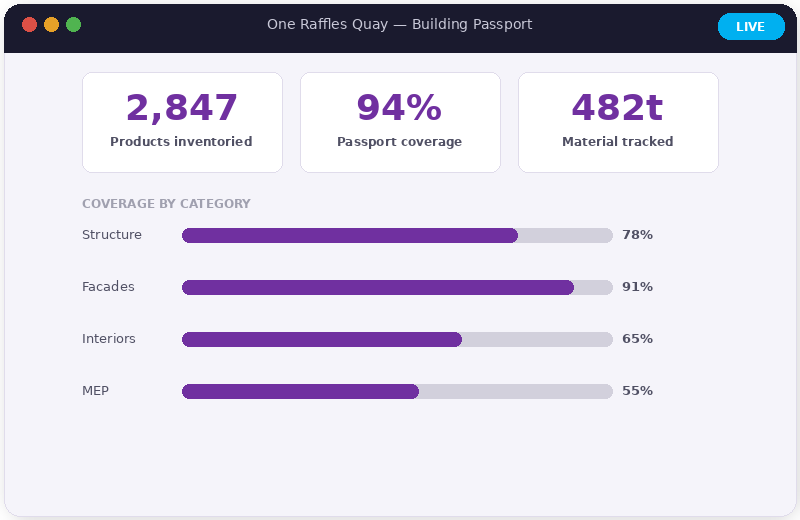
Material inventory: What materials are present in the building, in what quantities, in what locations, and in what condition. This includes structural materials (concrete, steel, timber), envelope systems (curtain wall, cladding, roofing), MEP systems (HVAC, electrical, plumbing), and fit-out components (flooring, partitioning, furniture systems where relevant).
Environmental credentials: The embodied carbon content of each material layer, referenced to verified Environmental Product Declarations (EPDs) or the emission factors in the Singapore Building Carbon Calculator (SBCC). This transforms the building from an opaque carbon liability into a transparent, auditable asset with a known environmental profile.
Component identity: Individual identification of significant components — structural elements, facade modules, MEP equipment — enabling tracking of warranties, maintenance cycles, and end-of-life eligibility for reuse.
Lifecycle events: A timestamped record of interventions — retrofits, component replacements, condition assessments — that updates the building’s material and carbon profile over time.
Reuse potential flags: Indicators that identify components suitable for secondary deployment at end of life, enabling pre-demolition planning and connection to urban mining platforms.
Why Singapore Needs Building Passports Now
The 2025 Built Environment Decarbonisation Technology Roadmap, developed by BCA, SGBC, and A*STAR, explicitly identifies material carbon transparency as a foundational requirement for Singapore’s transition to a low-carbon built environment. This is not aspirational language. It describes a practical precondition: without knowing what materials are in buildings and what carbon those materials represent, it is impossible to set credible embodied carbon reduction targets, impossible to benchmark performance across the sector, and impossible to verify progress over time.
The roadmap situates this challenge within Singapore’s national climate commitments under the Singapore Green Plan 2030, which targets greenhouse gas emissions reductions to 45-50 MtCO₂e by 2035. The built environment sector contributes over 20% of national emissions. Operational carbon reductions through energy efficiency are well-advanced. The roadmap is clear that embodied carbon is now the frontier — and that addressing it requires data that currently does not exist at scale.
Three specific policy developments make building passports urgent:
Green Mark 2021’s circularity provisions: The latest Green Mark scheme includes criteria related to material transparency, adaptability, and deconstruction planning. Building passports are the natural vehicle for evidencing compliance with these criteria across a building’s full lifecycle, not just at the point of certification.
BCA’s embodied carbon calculation initiative: BCA has worked with JTC, NUS-ESI, and SGBC to develop the Singapore Building Carbon Calculator as an industry tool for carbon accounting in buildings. Building passports provide the structured input data that makes this calculator meaningful at scale — connecting project-level carbon accounting to portfolio-level and national-level aggregation.
GreenGov.SG requirements for public sector buildings: All new and existing public sector buildings must achieve Green Mark Platinum SLE standards. The government’s own estate is thus the most immediate, highest-volume context for building passport implementation — creating a public-sector demonstration effect that can catalyse private-sector adoption.
The Passport as Financial Infrastructure
The environmental case for building passports is clear. The financial case is equally compelling, and in Singapore’s sophisticated real estate investment environment, it may ultimately be more persuasive.
A building with a documented material passport is a different financial asset from one without. The passport reduces due diligence costs for transactions and refinancings. It enables more accurate residual value assessments, including the value of recoverable materials at end of life. It provides the documentation required by green finance instruments — green bonds, sustainability-linked loans, transition finance facilities — whose terms are increasingly tied to verified environmental performance data rather than self-reported estimates.
The SGBC has emphasised the role of green finance in accelerating the built environment’s decarbonisation, noting that Environmental Product Declarations (EPDs) and carbon transparency are increasingly required conditions for access to sustainability-linked capital markets. A building without a passport is a building that cannot fully participate in this capital market — a growing competitive disadvantage for owners and developers who want access to lower-cost green finance.
For investors and asset managers operating under TCFD-aligned reporting frameworks or Singapore Exchange (SGX) sustainability disclosure requirements, a portfolio of documented buildings with known carbon profiles represents a fundamentally lower-risk asset class than undocumented stock. The passport converts an opaque liability into a transparent, manageable, insurable asset.
Upcyclea’s Building Passport Platform: Designed for Singapore’s Regulatory Environment
Upcyclea’s building passport platform was designed from the ground up for Singapore’s specific regulatory, technical, and market context. It is not a European tool adapted for Southeast Asia. It is built on Singapore’s emission factor data, calibrated to Green Mark scheme criteria, integrated with the SBCC calculation methodology, and connected to the SUM urban mining platform so that end-of-life material flows can be planned from the first day of a building’s operational life.
The platform enables building owners, developers, and asset managers to:
— Create structured digital material records at any stage of a building’s lifecycle, from new construction through major retrofit to pre-demolition audit
— Calculate and track embodied carbon profiles using SBCC-referenced emission factors
— Generate documentation for Green Mark submissions, ESG reports, and green finance applications
— Identify and flag components eligible for recovery and reuse, connecting directly to the SUM secondary materials marketplace
— Share verified data with tenants, investors, financiers, and regulators through controlled access protocols
The building passport is not an administrative burden. It is the data infrastructure that makes Singapore’s built environment legible, tradeable, and progressively more circular. It is the answer to the question that every regulatory framework and every investor is increasingly asking: what is this building actually made of, and what will happen to those materials when it comes down?
Upcyclea’s Building Passport platform is operational in Singapore. To learn more about implementation for your portfolio or project, contact our Singapore team or book a demonstration through our website.
References: BCA/SGBC Built Environment Decarbonisation Technology Roadmap (2025); Singapore Green Building Masterplan 4th Edition (2021); BCA Green Mark 2021 Scheme; Singapore Building Carbon Calculator, NUS-ESI/JTC/BCA/SGBC; SGBC Carbon Resources documentation; SGBC-BCA Embodied Carbon in Buildings Calculation Guide.