
Regulations
Decarbonation
Achieving carbon neutrality
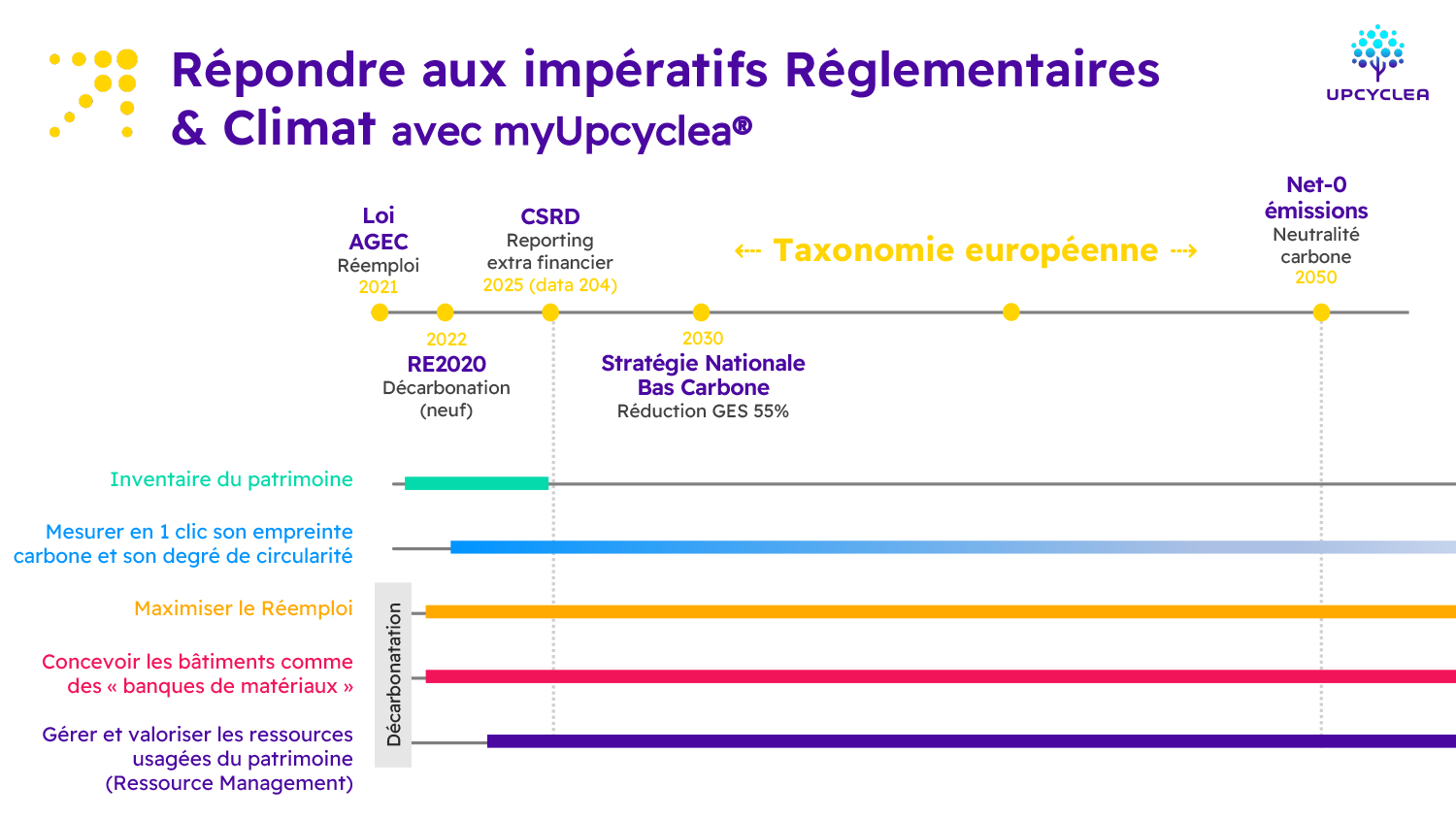
Carbon neutrality is the achievement of zero net greenhouse gas (GHG) emissions. This is a key challenge if we are to comply with the Paris Agreement and limit global warming to 1.5°C by 2050. Regulations to achieve this objective are multiplying and becoming increasingly stringent, particularly in the building sector.
To meet these regulations, it is necessary to integrate this objective into an overall sustainable development approach, offset the emissions generated and support energy transition initiatives. Cooperation and knowledge sharing are essential for a low-carbon future.
AGEC Act
The Anti-Waste for a Circular Economy Act (AGEC) is a French regulation aimed at transforming production and consumption models to limit waste and preserve natural resources. Promulgated in 2021, it introduces several measures that directly impact the building sector and social landlords.
The AGEC law requires the reuse of materials from the deconstruction or rehabilitation of buildings, the reduction of construction waste, and the use of construction products with a low environmental impact.
It also encourages the development of the circular economy through various measures, such as the extension of producer responsibility to the entire product life cycle.


RE2020
Réglementation Environnementale 2020 (RE2020) is the new French regulation designed to improve the energy and environmental performance of new buildings. Coming into force in 2022, it replaces the previous thermal regulations (RT2012) and introduces new criteria for assessing the carbon impact of buildings over their entire life cycle.
RE2020 imposes stricter requirements in terms of energy efficiency, renewable energy consumption and reducing the carbon footprint of materials and equipment. Among its quantified targets, the RE2020 calls for a reduction of at least 30% in CO2 emissions from new buildings compared to RT2012.
CSRD
The Corporate Sustainability Reporting Directive (CSRD) is an important EU regulatory framework aimed at strengthening sustainability reporting obligations for listed companies and financial entities. This directive plays a crucial role in promoting transparency and accountability in corporate sustainability.
The CSRD (Corporate Sustainability Reporting Directive) has three key objectives. Firstly, it aims to strengthen transparency in sustainability by requiring listed companies and financial entities to provide detailed information on their environmental, social and governance (ESG) performance. Secondly, it promotes the comparability and reliability of information by harmonizing sustainability reporting standards. Finally, the CSRD aims to stimulate investment in sustainable activities by providing clear and reliable information on companies’ ESG performance.

SNBC
The Stratégie Nationale Bas Carbone (SNBC) is an action plan put in place by the French government to achieve carbon neutrality by 2050. The SNBC aims to reduce greenhouse gas emissions in all sectors, including construction.
This means rethinking the design, construction and refurbishment of their real estate assets, integrating low-carbon and energy-efficient solutions. The SNBC sets intermediate targets, such as a 40% reduction in GHG emissions by 2030 compared with 1990.
European Taxonomy
The main aim of the European Taxonomy is to promote sustainable investment, encourage innovation and mobilize financial resources towards projects that are truly aligned with the ecological transition. It is based on rigorous scientific and technical criteria for assessing the sustainability of economic activities.
It establishes specific categories of economic activity, known as “sustainable investment sectors”, which are considered to be in line with the European Union’s environmental objectives. These objectives include the fight against climate change, the protection of biodiversity, the sustainable use of resources and the transition to a circular economy.
